Measure Twice, Water Once
A look at the high-tech tools golf course superintendents use to manage and conserve water.
When it comes to the tools golf course superintendents use to monitor and conserve water, there’s Old Tech and New Tech. Old Tech is akin to how we average Joes once dealt with our lawns. Big ol’ brown spot? Set the whirligig on it for a few hours till a mini swamp settles in. There — that’ll teach it.
Yes, a handful of crusty course supers still go by visual cues, gut feeling or “what’s always worked.” New Tech is a whole other deal. The sophistication of water management has improved in proportion to the cost and scarcity of water, especially here in parched Southern California.
Whether it’s achieved via Old or New Tech, water conservation is a universally shared mindset in SoCal golf. “It’s one of our biggest responsibilities in Southern California,” says Michael Wolpoff, superintendent at Arroyo Trabuco GC in Mission Viejo. “But the good news is that what’s good for water stewardship is usually good for playability, too. Firmer conditions make for better golf and healthier turf.”
POKING AROUND
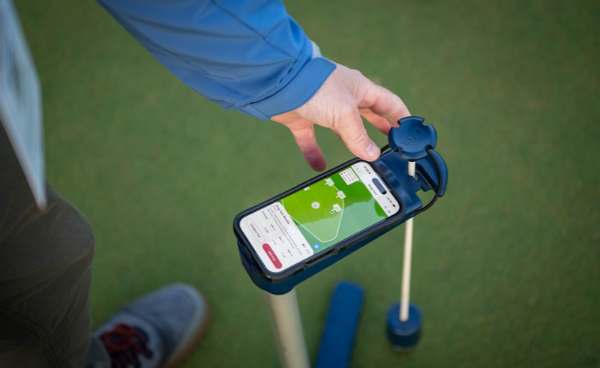
New Tech water tools begin with moisture meters — handheld probes that managers poke into their turf to find out what’s happening in the root zone. The meters not only read the precise moisture content, but also temperature and salinity. Temperature helps to indicate the rate at which the turf is or isn’t drying out. It might also suggest applying a “syringe” to the turf — like a mister on a Palm Springs sidewalk— to cool it down.
The salinity reading is crucial for courses that utilize reclaimed water, which tends to be high in salts that need to be leached. If rainfall isn’t doing it, irrigation might have to. But how much or how little? The numbers tell. Instant delivery on salinity level is a huge boon, considering that such readings used to require sending soil samples to a lab.

CRUNCHING NUMBERS
Moisture meters deliver all that data — including precise GPS readings to pinpoint zones of concern — via Bluetooth to proprietary apps that assist supers in making irrigation decisions. Here’s another arena
in which New Tech shines: computerized irrigation systems that let supers control water delivery — amount and location — with pinpoint precision.
“Ease of adjustment is the big advantage versus a system that’s not computer controlled,” says Heather Schapols, consulting agronomist for the USGA Western Region. “Otherwise you’re relying on someone to go out to each individual station. With a computer, you can sit down and do all of those adjustments in one place.”
Systems like the Rain Bird CirrusPRO allow supers to control not just zones, but individual sprinkler heads — of which there might be thousands on the course — all from a computer, tablet or phone.
We’re not done crunching numbers yet. Because above-the-ground data is also valuable, supers can further refine their strategies with numbers delivered from on-course weather stations. Readings on temperature, humidity, rainfall, wind and solar radiation all figure into a calculation known as evapotranspiration (ET) — the movement of water from the soil surface by way of evaporation and from plants through transpiration. Knowing all of that, supers can crunch irrigation run times down to the second.
MICROWAVING THE GOLF COURSE
Poking around with a moisture meter for readings at specific locations is valuable, but an 18-hole golf course is a big place. How to get readings everywhere? Enter turfRad, a system that mounts on a mower and calculates microwave emissions from the soil that correlate to moisture level, turfRad can take multiple readings every second and deliver as many as 10,000 moisture readings on a single fairway. A software tool in turn integrates data from the scan and can adjust course-wide sprinkler times.
“We’ve been using turfRad since spring 2023, and it’s become one of our most valuable irrigation management tools,” says Arroyo Trabuco’s Wolpoff. “We estimate about a 10 percent reduction in water use, but even more important, it’s created more consistent playing conditions.”
Which is an additional upside to New Tech tools: As Wolpoff noted earlier, playability and water management go hand in hand. Adds Brian Whitlark, western regional director for the USGA Green Section’s Course Consulting Service, “A wet golf course is not a fun golf course to play, and a wet golf course results in damage from golf cart and maintenance traffic as well as disease and weed contamination.”
Fortunately, in this modern era of water scarcity and sophisticated tools, wet golf courses in SoCal are as rare as July rainstorms.