Jim Murray
A Peerless Scribe with a Passion for Golf
WHO IS THE GOAT? sparks countless grill-room debates. Is Tom Brady the greatest quarterback of all time? Probably. Michael Jordan at basketball? Indubitably. Tiger Woods or Jack Nicklaus at golf? Coin flip. When the subject turns to the best-ever sportswriter, all discussion and division stop. No one in any era was better at putting words to paper than Jim Murray. Just ask his peers, who voted him National Sportswriter of the Year a record 14 times. For his spirit and skill in spreading the written word about golf’s glories, Murray was an enormously popular selection to the SoCal Golf Hall of Fame in 2008.
A GENUINE NEWSHAWK
Born in Hartford, Connecticut, in 1919, Murray graduated from Trinity College there and immediately began his journalism career. In 1944, he took a train to Los Angeles and snagged a reporter’s job at the L.A. Examiner. He covered the crime beat and found no shortage of material. He wrote, “… we slept with our socks on, like firemen waiting for that next alarm.”
Tired of the gore and heartbreak, Murray accepted TIME magazine’s offer of $7,000 in 1948. Among his duties were toiling as the magazine’s Hollywood reporter from 1950 until 1953, which put him in regular contact with the industry’s biggest stars, including Humphrey Bogart, Marilyn Monroe, John Wayne and Bing Crosby. The rapport and trust he developed with the Tinseltown elite served him well when sports came calling.
Murray got his first sports assignment at TIME by default, but he proved to be so good at it that TIME publisher Henry Luce enlisted him in 1953 to help start Sports Illustrated. In 1961, Murray left SI for a gig with the Los Angeles Times. For the next 37 years, he wrote four 750-word columns per week, every one of them gold. Arnold Palmer had two of them bronzed.
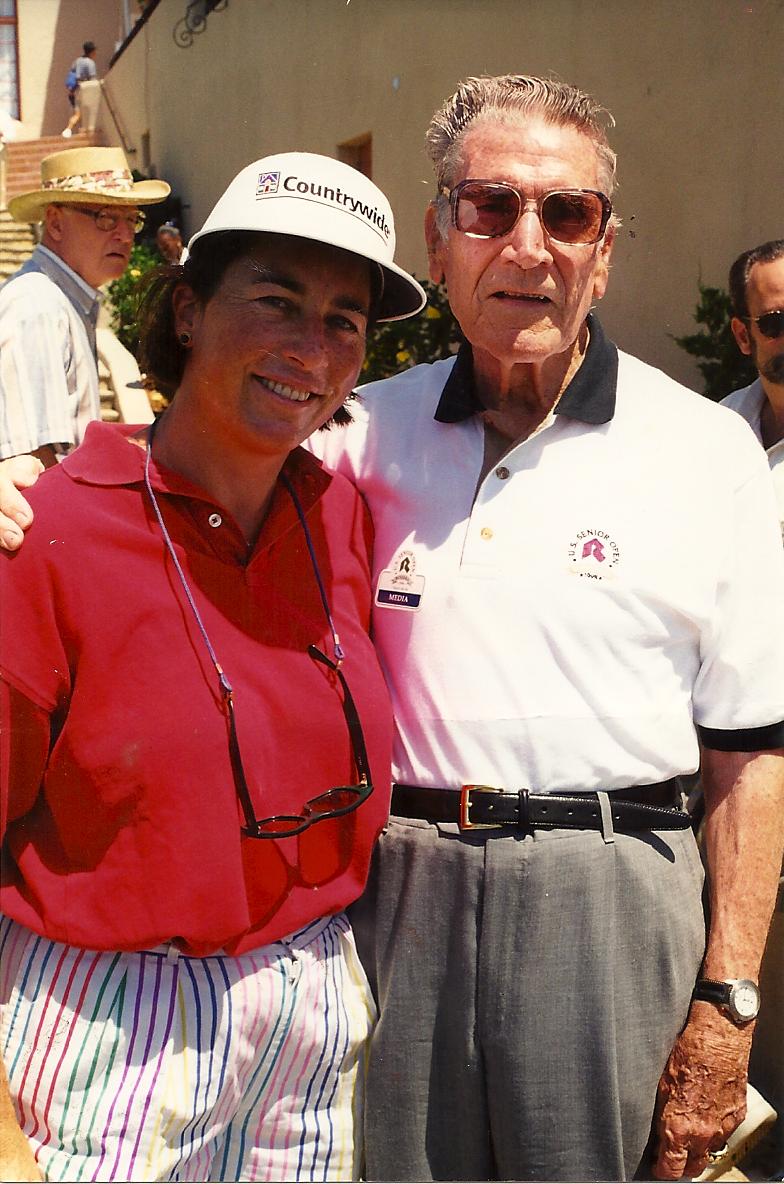
A SPECIAL SPOT FOR GOLF
Murray blazed a unique trail of rapid-fire, bada-bing one-liners about sports events and people that made us think and laugh.
On the Indianapolis 500: “Gentlemen, start your coffins.”
On the massive size of Los Angeles Rams Hall of Fame defensive tackle Merlin Olsen: “… went swimming in Loch Ness — and the monster got out.”
“John McEnroe without a racket in his hands is a perfectly plausible, reasonable young man. With a racket in his hands, it’s like the moon comes out and he begins growing fangs and face hair and foam forms at his mouth.”
Other times, he made us think and fume. His poignant, pointed comments to the Baseball Hall of Fame and Masters poohbahs that were far too slow in allowing Black athletes through the doors helped raise awareness of the perceived injustice.
Golf unquestionably held an exalted place in the Murray oeuvre. As his longtime Los Angeles Times editor Bill Dwyre wrote in FORE in 2017, “Murray wrote with unmatched fluency and creativity about all sports. About golf, he wrote with inspiration.
On Arnold Palmer: “Arnold turned a golf round into Dempsey-Firpo. A war. He didn’t play a course. He invaded it.”
“Severiano Ballesteros goes after a golf course the way a lion goes after a zebra.”
On being invited to play exclusive The Los Angeles CC: “Usually I play golf with the kind of people who rob banks, not own them.”
On The Riviera CC, his home course: “It used to be a hustler’s paradise … you could get a bet on the color of the next dog coming up the fairway.”
On Spyglass Hill GC: “If it were human, Spyglass would have a knife in its teeth, a patch on its eye, a ring in its ear, tobacco in its beard, and a blunderbuss in its hand.”
Murray achieved a professional goal in 1990 when he was awarded the Pulitzer Prize for commentary. Typically, he downplayed the achievement. “I never thought you could win a Pulitzer just for quoting Tommy Lasorda correctly.”
He also earned the BBWAA Career Excellence Award in 1987, presented to him at the Baseball Hall of Fame Induction ceremonies the following July. In 2002, the Golf Writers Association of America established the Jim Murray Award, given to a professional player for his/her cooperation, quotability and accommodation to the media and for reflecting the most positive aspects of the working relationship between athlete and journalist.
Jim Murray was that extremely rare sportswriter who was every bit as legendary as the stars he covered. Once, when he couldn’t attend an awards dinner, he found someone to substitute for him: Bob Hope. After a Lakers playoff game in 1979, Muhammad Ali bumped into Murray outside the locker room and hollered, “Jim Murray! Jim Murray! The greatest sportswriter of all time!”
It was a classic encounter. GOAT recognizing GOAT.