Vincent Johnson Tees Up
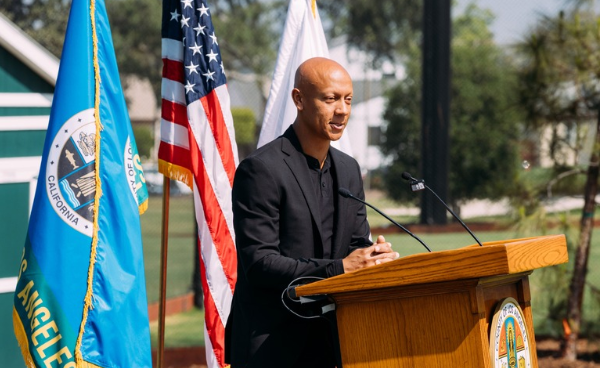
LA County Parks’ new(ish) director of golf is determined to grow the game by lowering barriers and promoting the value of accessible public courses.
When Vincent Johnson took the job of LA County Parks director of golf in 2025, he brought with him a long track record of muni golf management in his hometown of Portland. But he was no stranger to our local turf. He had played SoCal tournaments as a collegiate golfer for Oregon State. As a pro on the APGA Tour, he won the Long Beach Open in 2010, and recently was awarded an APGA Lifetime Achievement Award. He was also the first recipient of the Charlie Sifford Exemption at The Genesis (then Northern Trust) Invitational, named for the first African American to compete and win on the PGA Tour.
It was that combination of municipal course manager and erstwhile pro that made him an attractive candidate for the director position, according to his predecessor, Jorge Badel, PGA. “His experience managing the complexities of a municipal golf course system shows not only operational competence but a deep respect for how community golf works,” says Badel. “He’s an accomplished player, but he never loses sight of what it feels like to be new to the game. He understands the barriers and the small victories that define the entry-level experience.”
So how does Johnson view the challenges and opportunities of managing 20 public courses in 18 locations in LA County? We put some questions to him.
FORE: You were a pretty successful pro. Why and how did you transition into course management
JOHNSON: Well, at some point you shoot enough 72s and your pro golf career doesn’t last long.
I had a huge passion for teaching. I found it fulfilling to give back, to connect
to folks who are earlier in their golf experience. Eventually, Portland Parks and Recreation was looking to advance the game — and growth and diversity in the game — and I found a role there as assistant golf director. It meant a lot to me to be a part of the growth of a system I grew up in. When the previous director retired, I applied and was appointed director. I worked at Portland Parks for eight years.
How do you see the place of munis in general, and more specifically, here in SoCal?
What sticks out for me is how many people call them home. It’s how most folks who play touch the game of golf. Munis are integral to the whole golf ecosystem.
Here in Southern California, I think about player development, grow-the-game initiatives, where our courses sit in communities, the open space they provide and the connection points they are for so many for people.
Do you think folks are aware what a treasure our muni courses are?
A lot of folks see how nice our courses look and assume they’re country clubs! What’s accessible to the public here is remarkable. Think about green fees. A lot of affordability here, and our par-3 and executive courses, mean you can get a golf experience at an even more affordable rate. When people learn that, it changes their perspective of what golf is.
So how do you build that awareness?
Our director (of county parks), Norma García-Gonzalez, is outspokenly supportive of golf and always looking to get the word out, working with our communications and marketing team. There are always opportunities to share that story, to underscore what municipal golf is and what LA County golf is.
The Maggie Hathaway project would be one example, right?Yes. I was humbled to come in after a lot of groundwork had been laid. So much energy and passion from our partners, American Golf and the Maggie Hathaway Foundation. Having Gil Hanse design the course and shape the greens. Most of all, what it was adding to the community in South LA and the legacy of Maggie Hathaway. Word is out. We’re getting new faces on the course, folks coming from all over to play. Rounds have almost doubled.
Which leads us to the question of how to encourage diversity in the game.
Youth golf plays such an important role. We have a partnership with Youth on Course. Members pay no more than $3 to play. If you’re able to lower barriers, a broader audience can experience the game. Location plays a big role too. Maggie Hathaway, for example, is in a historically and predominantly Black area. We want to be able to serve such communities and let them know that golf is a game for them.
We also have partnerships with SCGA Junior, obviously, and SAYPI — Southern Area Youth Programs — and First Tee. We’re launching the LA County Parks Youth Golf Program, which includes
a drop-in class called Drop Zone and a summer camp called Future Fairways. Those connection points provide programming and mentorship and let a lot of folks believe that golf is a space for them.
Any sustainability initiatives we should know about?
Well, Maggie Hathaway was planned with sustainability in mind — drought-tolerant turf and plants, an updated irrigation system. Staying on the cutting edge takes invest-ment, but Maggie Hathaway is a great example of sus-tainability when we have the opportunity. On another note, we supported San Dimas Raptor Rescue with a fund-raiser in October at Marshall Canyon GC. That underscores how our golf courses provide open space and habitat.
Where do we stand with the fight against illegal tee-time brokering?
Our deposit and cancellation policy has helped to curb that, and we’re excited about sup-porting Assembly Bill 1954, which prohibits a third-party from selling golf reservations for a golf course owned by a local public agency without a written agreement. It passed with the governor’s signature in September. That will be a really positive thing.