Picture Perfect

After a major renovation of its course, practice facilities and clubhouse, The Farms GC makes a case to be counted among the best clubs in the U.S.
Andy Jones, the president of The Farms GC in Rancho Santa Fe, has been leading a guest on a tour of the newly renovated clubhouse for more than an hour. He’s pointed to a fascinating array of reimagined spaces, fresh art and photos, prized golf club collections and high-tech displays that feature The Farms’ past and present.
Yet the moment when Jones’s face truly lights up is when he stands at the top of a stairwell and waves his hand at a massive watercolor painting on the wall. “This painting, to me, carries so much significance,” he says.
The piece, commissioned for the club’s opening in 1988, portrays a scene from behind the fourth hole, with the eye drawn toward a small wooden bridge that traverses a lake. The water is lined with the signature railroad tie pilings of one Pete Dye, the renowned course designer who led the creation of The Farms.

What excites Jones is the view of a mysterious finger of water on one side of the bridge that many members never knew existed, even if they’ve passed the painting countless times. Over decades, the water became completely obscured by acacia shrubs, and in that Jones saw symbolism for the entire club. The Farms was approaching its late 30s and much of its lore was being either forgotten or taken for granted.
That was unacceptable to Jones, a 45-year-old career land broker whose experiences at some of America’s most storied clubs left him with a deep-seated desire to more enthusiastically savor the history at The Farms, a wholly golf-centric club whose membership represents the richness of the region’s ties to the game — big-name professional athletes, golf manufacturing leaders and one of the largest stables of single-digit sticks in Southern California.
“We’re celebrating the history that, candidly, no one knew about,” Jones said as he stood beside that watercolor painting. “Only being here 15 years, I was carrying this wealth of knowledge that even our oldest members had basically forgotten about. And it was going to evaporate and never exist if we didn’t bring it to life.”
The Farms is now alive with a buzz it arguably hasn’t had since its very early years, and it goes far beyond new paint on the clubhouse and a reimagined interior. What began as a project to replace the worn course turf and aging irrigation system became the most extensive transformation of the club ever.
Jones and The Farms’ board, with a majority support of the membership of just under 400, undertook a $22 million project that includes a full renovation of the layout by Dye disciple Tim Liddy; the construction of a two-story, 4,735-square foot building with a hospitality deck, a performance center and the exclusive home for the San Diego State University (SDSU) men’s and women’s golf teams; and a new, high-tech driving range and acre-plus practice area designed by architect Mike Angus.
Among those supportive of the renovations from the beginning was Al Severson, who is the longest-standing Farms member, along with his good friend Gary Deems. Severson joined the club for an initial fee of $37,500 before any dirt was turned and watched the original design in ’88 come to life under the direction of Pete Dye, his son Perry and consulting PGA Tour player Tommy Jacobs.
Severson’s son Jason now serves on The Farms’ board of directors, and the elder Severson said the renovation has far exceeded his expectations.
“I think it’s quite a miracle, quite an accomplishment,” he said. “There was a window that opened for us to take the course to the next level, and this leadership team had the courage to take the steps to do it. The amount of determination and commitment these guys showed was just extraordinary.”
UNCOVERING ITS BEAUTY
The Farms has always been known for the dedication of its golfers and the difficulty of its track. Dye squeezed a golf course into 85 acres, and beyond his usual features of mounding and water and railroad ties, the fairways were downright claustrophobic. It presented a welcome, stern test for early members such as Annika Sörenstam and Tom Lehman, and at one time the club’s membership ranked near the top in the U.S. for the most players with single-digit handicaps.
Getting roughed up in your skort or Bermuda shorts wasn’t for everybody, however, and it no doubt cost the club some membership interest. “You have to have a certain mentality to be a member here; you have to be resilient,” said Severson, who added with a laugh, “I have friends I ask to play The Farms and they say, ‘I think I’ve got to mow the yard.’”

The Farms kept that reputation even after Lehman and fellow PGA Tour pro John Fought were hired to somewhat “soften” it. They lopped off many of Dye’s mounds, but in the process added the acacia that ended up becoming just as penalizing as it began to overgrow in areas such as the pond in the painting. Member PGA Tour players such as Xander Schauffele, Charley Hoffman and Emiliano Grillo liked it because it helped sharpen their precision, but regular golfers just found the plants to be one more place where golf balls disappeared.
Still, there weren’t grand ideas to overhaul the course until Jones and his highly regarded superintendent of nearly 20 years, Troy Mullane, went looking for advice on replacing Dye’s now-rotting signature railroad ties that edged the water features. They were referred to Tim Liddy, an Indianapolis-based architect who had worked alongside Dye for more than a quarter century.
In the middle of renovations on Dye’s courses at PGA WEST, Liddy came to take a look and noted all of the ways in which Dye’s work at The Farms had been eliminated. So inspired were Jones and Mullane by Liddy’s insight that they convinced the board and members to hire Liddy to restore much of Dye’s aesthetic while also making the course more playable for average golfers. It didn’t hurt Liddy’s cause when his eyes welled up with tears when he spoke of his relationship with Dye in a meeting in front of the membership.
Liddy, 73, is calling the finished project “the best course I’ll ever do.”
“This is the best budget, the best client, the best site I’ve ever had,” he said. “I did a course in Scotland, near St Andrews, that is close to my heart, but The Farms was just a great experience all around.”
With new mounding, fresh bunkers, cleverly shaped green surrounds that cradle shots instead of repelling them and more generous runways to the greens, The Farms is playable for more golfers than it’s ever been before.
“That was a big deal,” Severson said, “and I think Liddy really plugged into that.”
GIVING BACK TO THE GAME
The significant changes in nearly every corner of the club have come with a vision from the top — most notably over the past three years of Jones’ presidency and the eight years that Scott Heyn has been the general manager.
“What makes us a great place and a great hang is that you know anyone who walks through our gates; they’re here because they love golf,” said Heyn while noting there isn’t a pool or pickleball courts. “And it’s just really easy for people to meet each other and connect because we have that in common.
“Everything we’ve done in this project really is centered around our core mission, which is to be one of the best clubs in America.”
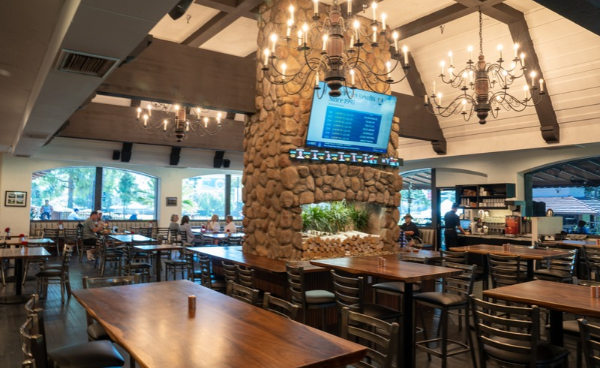
Jones joined the club in 2011 at a down time for private facilities in the aftermath of the Great Recession. He watched, noted things he liked and didn’t like and began to nudge a shift in the club’s culture. Years ago, he created a summer league to break up cliques and get more members socializing with each other. With even more sway as president, Jones has done away with separate men’s and women’s grilles, with the largest room now serving as the main dining spot and the smaller being a family room with games and big TVs.
Among the many displays that have been created in the clubhouse, there are personalized shadow boxes for each club president, a wall hanging that lists the membership’s current college players and various areas that recognize staff members. To wit, on the wall next to locker room manager Jose Rangel’s counter is a Cooperstown-style plaque that honors the work he’s done since the club opened. Reads the tribute: “Jose is not just part of The Farms; he is The Farms.”
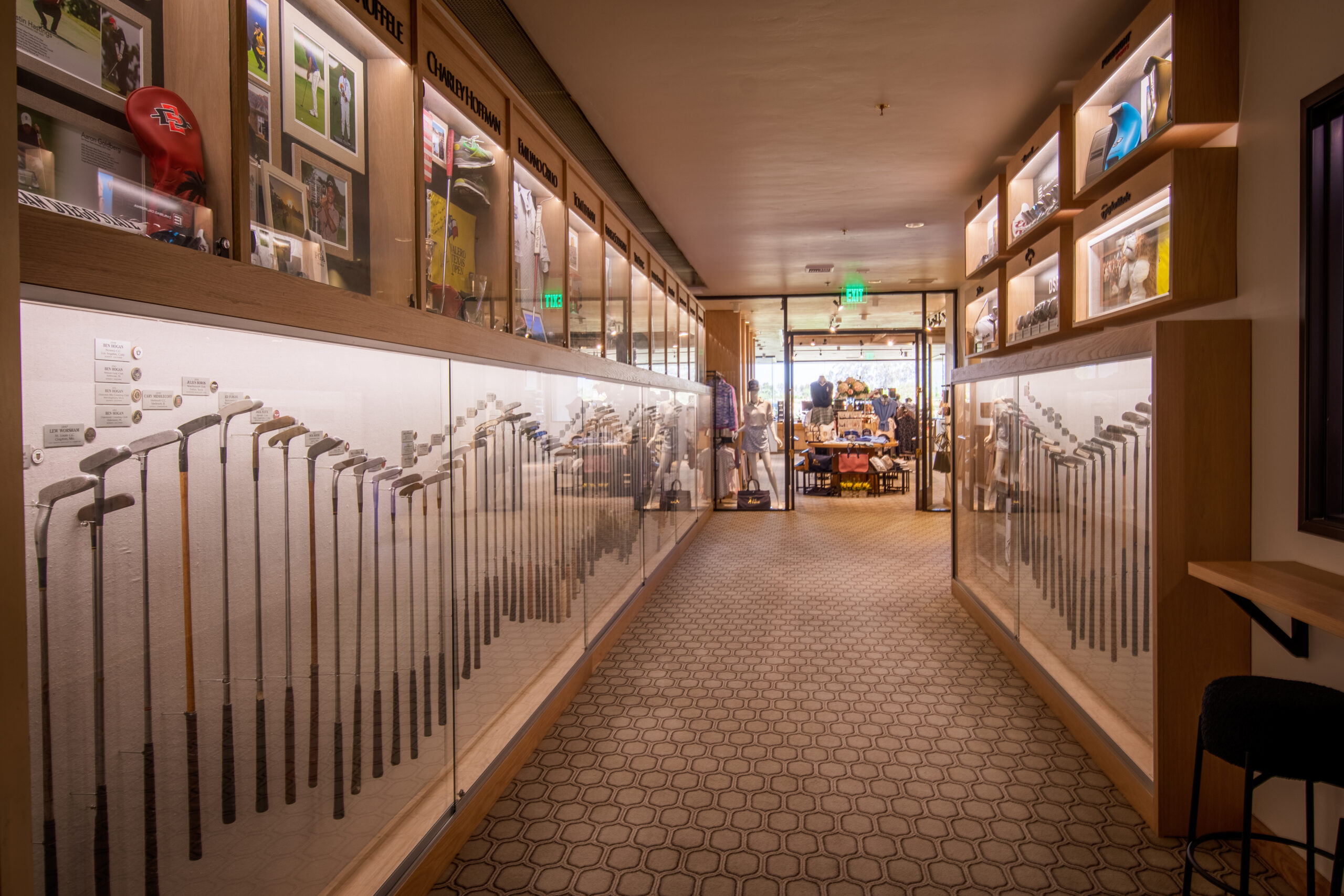
The club’s first level is where members and visitors can soak up the club’s rich history with museum-quality displays. In the refresh, there are glassed cases for each of the club’s prominent professional members, who were invited to help decorate them. Hoffman, for example, donated the putter from his first PGA Tour win and a crystal goblet for leading a round in the Masters. On a facing wall, there’s a display honoring two late members who were giants in golf equipment innovation — Ely Callaway and Dick Helmstetter. And then there is The Farms’ historic pièce de résistance — replica putters from U.S. Open winners dating back to the early 1900s.
A walk outside the main clubhouse reveals the club’s promising future. Built on a hill next door is a sleek, modern structure, first envisioned by Angus, that has been dubbed “The Farms House.” It features a snack shop and patio on top and indoor-outdoor bays on the bottom with the latest practice and testing technology, along with club-fitting offerings from Callaway and TaylorMade.
Most striking is a room that sports enormous SDSU logos because it will serve as the first true “home” facility that the Aztecs men’s and women’s golf teams have ever had. After playing the course or working at the short-game area, the golfers can grab snacks, socialize, do homework and, yes, hit more balls. SDSU’s golf teams raised $3 million to contribute to the project and will have access to the facilities for at least the next 20 years.
While SDSU’s women’s team has held practices at The Farms for many years, the men are getting their first true taste of it.
“The most impressive thing so far is I was a little bit not sure about going to a high-end private club,” said Ryan Donovan, SDSU’s men’s head coach for 23 years. “It’s been the opposite. Everybody has just made us feel really welcome.”

With the newness of so many things at The Farms now, there also seems to be a fresh sense of pride and a desire to show off the place. The club is actively accepting overtures from top-level events and among those already on the books are the Men’s and Women’s Pac-12 Championships (2027 and 2028, respectively), U.S. Mid-Amateur Qualifier (2029) and California Amateur Championship (2032). Each one of those is a big-time “get” for a club looking to reestablish its prominence.
Severson, who has been there through every chapter at The Farms, has observed these latest developments and aspirations with a sense of awe and pride for a club he believes has the larger good of golf in mind.
“It’s the membership at The Farms and their respect for the game,” he said. “If you love it, if you’re a student of it, if you respect it, I think it’s an obligation we have to give back to it.”