Bill Spiller
He broke the color barrier with courage and conviction.
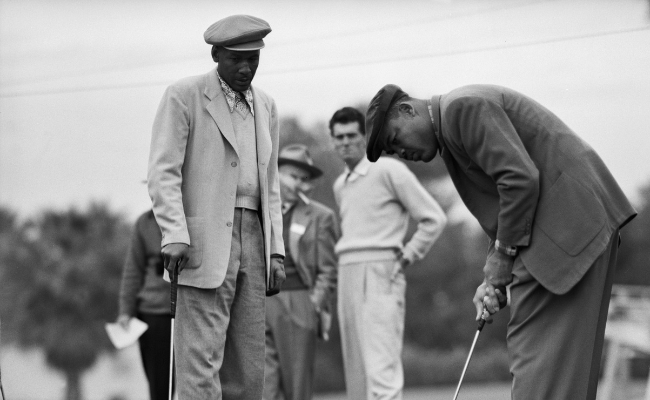
Bill Spiller encountered injustice everywhere. One of the most talented professional golfers of the 1940s, Spiller was denied the opportunity to compete at the highest level, or even find a job in the industry, due to the color of his skin. His actions in that decade and beyond make him golf’s greatest unsung legend.
Historian Al Barkow, who interviewed Spiller for his oral history, Gettin’ To The Dance Floor, put Spiller’s accomplishments in perspective. “Bill Spiller is a hero,” wrote Barkow, “but unappreciated. Charlie Sifford gets a lot of the credit for breaking the racial barrier, but Bill Spiller paved the way.”
ROADBLOCKS AND RAGE
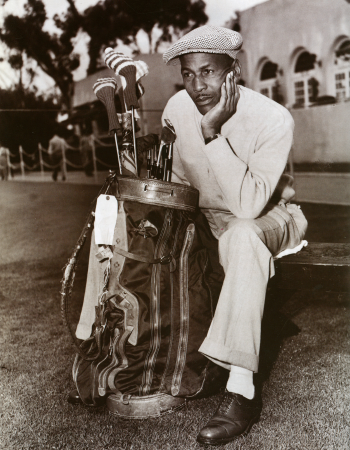
Born in 1913 in Tishomingo, Oklahoma, Bill Spiller earned a college degree in Texas, yet couldn’t earn a livable wage as a teacher, so in 1938, he moved to Los Angeles, where his mother lived. Four years after he took up golf in 1942, he was the equal of any black golfer in Southern California, and one of the best in America, as illustrated by his success in United Golfers Association tournaments, with fields made up almost exclusively of Black players.
He could really play. Frank Snow, a disciple of Spiller, assessed his mentor’s game, telling Barkow that Spiller possessed moderate length off the tee, was very accurate through the bag and was a steady, conservative golfer with an excellent touch around the greens. Added Charlie Sifford, “[Spiller] was a great golfer, one of the best ever, Black or white.”
Still, Spiller yearned for the bigger prizes — and purses. He qualified for the Los Angeles Open in 1948, a tournament that operated by its own set of rules, and blew the doors off The Riviera CC, with a first-round 68, tied for second with Ben Hogan. Although he couldn’t keep pace with eventual winner Hogan over four rounds, he tied for 29th. By virtue of his finish in the top 60, however, Spiller qualified automatically for the next PGA Tour event, the Richmond Open in the Bay Area.
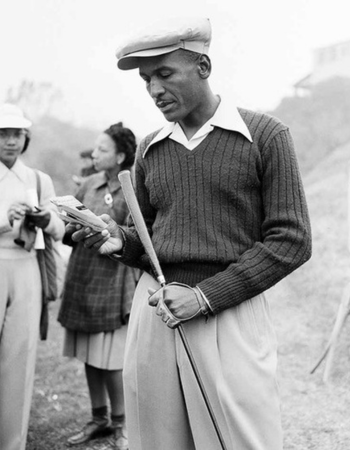
After a practice round in Richmond, Spiller was informed that he couldn’t play. He was not a member of the PGA of America, a requirement for competing in tournaments the PGA co-sponsored. There was no way to become a member, either, because a clause written into the PGA’s constitution in 1934 restricted membership to “Male professional golfers of the Caucasian race.”
Incensed, Spiller found a lawyer and sued the PGA. Shortly before the court date, a deal was struck. If Spiller dropped the lawsuit, the association would no longer bar Blacks from entering their Open tournaments. Spiller had been duped. Organizers changed their tournaments to “Open Invitationals.” Unsurprisingly, neither Spiller nor any other Black players appeared on subsequent invite lists.
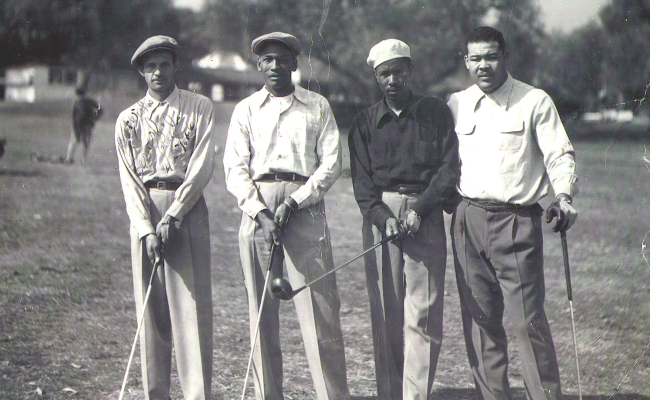
Another spark of hope emerged in 1952, when a new PGA Tour-affiliated event debuted in San Diego. Spiller was invited to qualify and made the field. Hoping to attract additional publicity, San Diego Open organizers placed the now-retired heavyweight boxing champ Joe Louis to compete as an amateur, without having to qualify. Once again, the PGA said, “no way.”
Eventually, Louis was permitted to play but not Spiller. Further incensed, Spiller climbed onto the first tee ahead of play in the opening round. When the first group arrived, he stood there, refusing to move, as a protest. Eventually, Louis talked him down and the tournament commenced.
Amid another lawsuit threat, the PGA established a policy where Blacks could play when invited by sponsors. With the new policy, Spiller was able to enter 10 tournaments that year.
FORGOTTEN FIREBRAND
By 1960, Bill Spiller had resorted to giving occasional driving range lessons and caddying at Hillcrest CC. When asked by member Harry Braverman why, with all of Spiller’s talents, he hadn’t secured a club professional job, Spiller informed him of the PGA’s Caucasian-only requirement. Braverman referred Spiller to California Attorney General Stanley Mosk, who was aghast at the predicament.
“I told PGA officials that it was illegal to bar a competitor because of his race,” Mosk told Sports Illustrated in 2001. In November 1961, 14 years after Jackie Robinson broke the color barrier in baseball, the PGA quietly dropped its Caucasian-only clause. Spiller had lost every battle but finally won the war.
Spiller died in 1988, embittered after years of blocked opportunities and poor physical and mental health. In 2009, he was at last granted a posthumous membership to the PGA of America and in 2026 was named to the SoCal Golf Hall of Fame, a recognition for which his descendants are grateful.
“To have Bill Spiller inducted into the Hall of Fame, it means comfort to us knowing that all he sacrificed to be recognized and just wanting a fair shot like his white counterparts, that somehow it has all paid off,” says Michael Spiller of his greatgrandfather. “There is also a feeling of grief, that it wasn’t until after his death was he recognized as someone equal.”
Michael Spiller was raised by his grandfather, Bill Spiller Jr., so he has a unique perspective on Bill Spiller’s legacy. “I would like people to remember the fight, that this wrong was so unjust that he fought and sacrificed his life, career, family, to make sure that it doesn’t happen to anyone else,” he says. “That someone, even if not himself, would benefit from his work and have the chance he was never given.”