DINAH
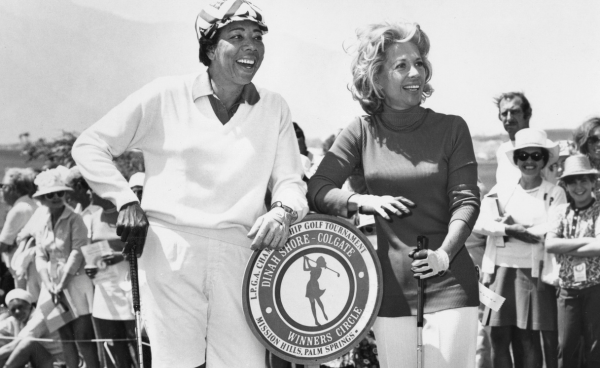
LPGA HISTORY is sprinkled with single-name stars: Babe, Annika, Nancy, Mickey. Yet it’s a woman named Dinah who boosted the profi le of ladies’ professional golf like no one before or since.
Frances Rose Shore was born in 1916 and spent her entire childhood and college years in Tennessee. Overcoming a bout with polio as a toddler made her self-conscious but also ambitious. She embraced athletic endeavors to overcome the physical issues that afflicted her right leg. While auditioning in New York City on summer break from Vanderbilt University, she would often sing the popular mid1920s song, “Dinah,” and soon that’s how she was known. The golden-haired, honey-voiced Southern belle radiated charm and talent in equal measure, leading to spectacular success, first as a chanteuse, then later as a television personality. Improbably, her enduring legacy revolves around golf.
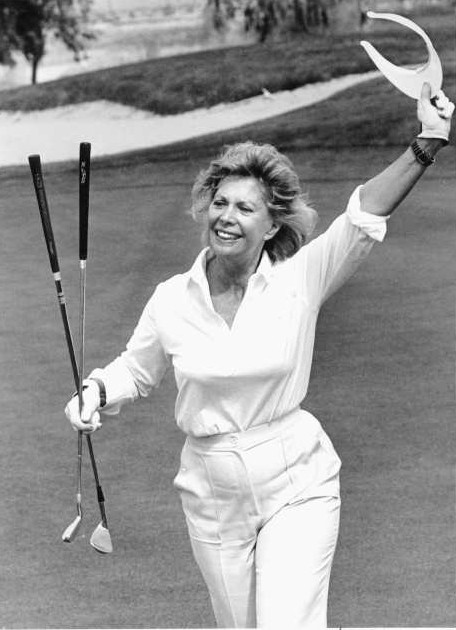
For the current generation, Shore is best remembered for her namesake tournament, the Dinah Shore, an LPGA major now called the Chevron Championship. Held for 50 years at Mission Hills CC in Rancho Mirage, the Dinah Shore debuted in 1972 and rocketed to immediate and lasting fame.
The event undeniably elevated the status of women’s golf and women in sports. It also shined a brighter spotlight on golf in the Coachella Valley and throughout Southern California. All credit to Dinah and her irrepressible magnetism for piloting the rocket.
“Dinah was exactly what you saw,” says Amy Alcott, who lifted the Dinah Shore winner’s trophy on three occasions. “Her eyes lit up. She was charming. She dressed well; she was attractive. In this day and age, she would be the perfect kind of brand representative or corporate spokesperson.”
RADIO AND TELEVISION SUPERSTAR
So well known was Shore for her golf tournament, it’s easy to forget what a giant she was in the entertainment industry. From 1940 to 1957, she placed 80 songs in the Billboard record charts, including “I’ll Walk Alone,” her first number-one hit; “Blues in the Night,” a gold record that sold more than a million copies; and “Buttons and Bows,” which topped the charts for 10 weeks and finished as the most popular song of 1948. She scored another smash in 1949 with the holiday staple, “Baby It’s Cold Outside,” alongside Buddy Clark.
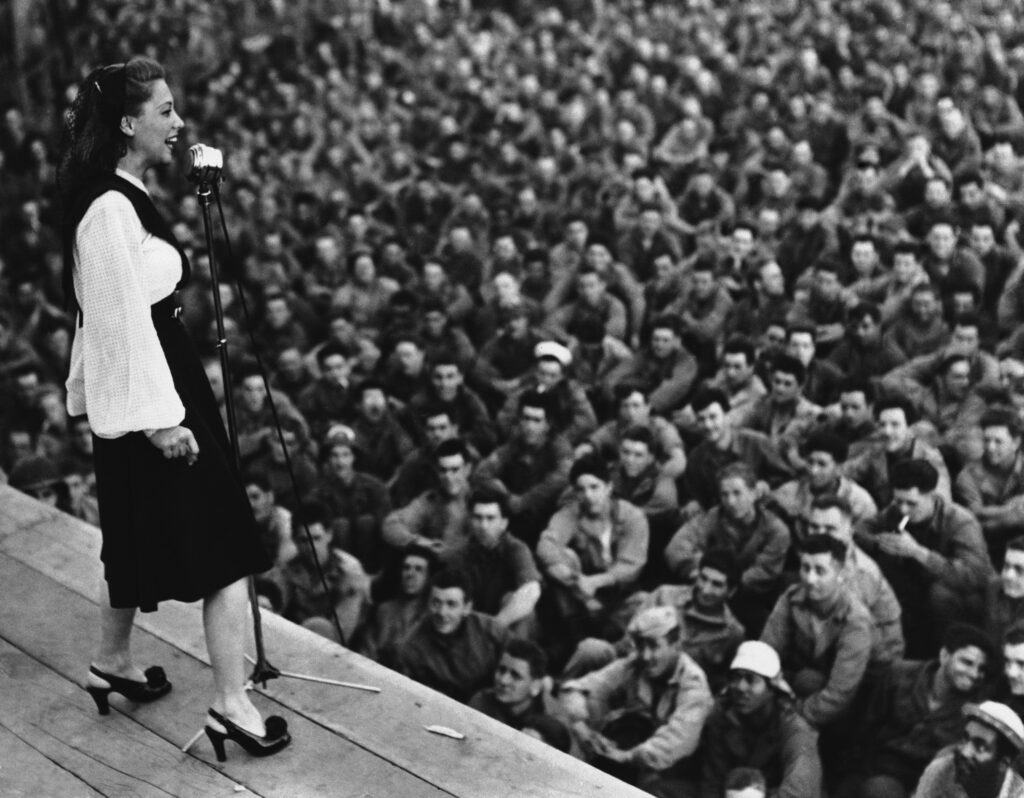
As Shore’s singing popularity ebbed, her stature as a television personality soared. After successful guest spots on many of the new medium’s top shows, including Bob Hope’s first network television program, Shore earned a host role of her own on NBC with The Dinah Shore Show.
Her appeal and influence continued to rise, leading to The Dinah Shore Chevy Show in 1957, where she would belt out her signature endorsement song, “See the U.S.A. in Your Chevrolet,” and sign off by throwing an exuberant kiss toward the cameras — and her audience.
In 1970, she began another run in the daytime arena with Dinah! (which later morphed into Dinah’s Place), which aired from 1974-1980. Her competitors in those years included the long-running Merv Griffin- and Mike Douglas-hosted shows, but Shore more than held her own thanks to a unique formula of showcasing entertainment titans who flocked to her program because she was so well-liked and admired. Those same stars would then show off surprising skills, such as Frank Sinatra or Burt Lancaster sharing a pasta sauce recipe, or Vice President Spiro T. Agnew tickling the ivories while accompanying Shore on “Sophisticated Lady.” Shore displayed exceptional prowess in the kitchen and authored three cookbooks.
In all, Shore garnered nine gold records, fistfuls of Emmys — for both Primetime and Daytime — and a slew of other accolades, from a Golden Globe to three stars on the Hollywood Walk of Fame, one each for Recording, Radio and Television. She wrapped up her career in 1992, after a three-year stint on TNN (The Nashville Network) with A Conversation with Dinah. TV Guide once ranked her 16th on its list of the top 50 television stars of all time. In short, Dinah was a dynamo.
THREE DECADES OF THE DINAH SHORE
Beyond Dinah Shore’s achievements in entertainment, she is a member of the LPGA Hall of Fame, the World Golf Hall of Fame and the SoCal Golf Hall of Fame for her golf tournament — and for what the tournament did to promote golf, especially women’s golf. How the game pulled her in is almost comical.
“The Colgate Co. was sponsoring my television show, and I was a tennis player,” Shore told the Los Angeles Times in 1992. “I didn’t play golf. However, the powers that be decided they were going to sponsor a golf tournament. I said make it tennis; I didn’t want to look like a dummy in two sports … I took a crash course in golf.”
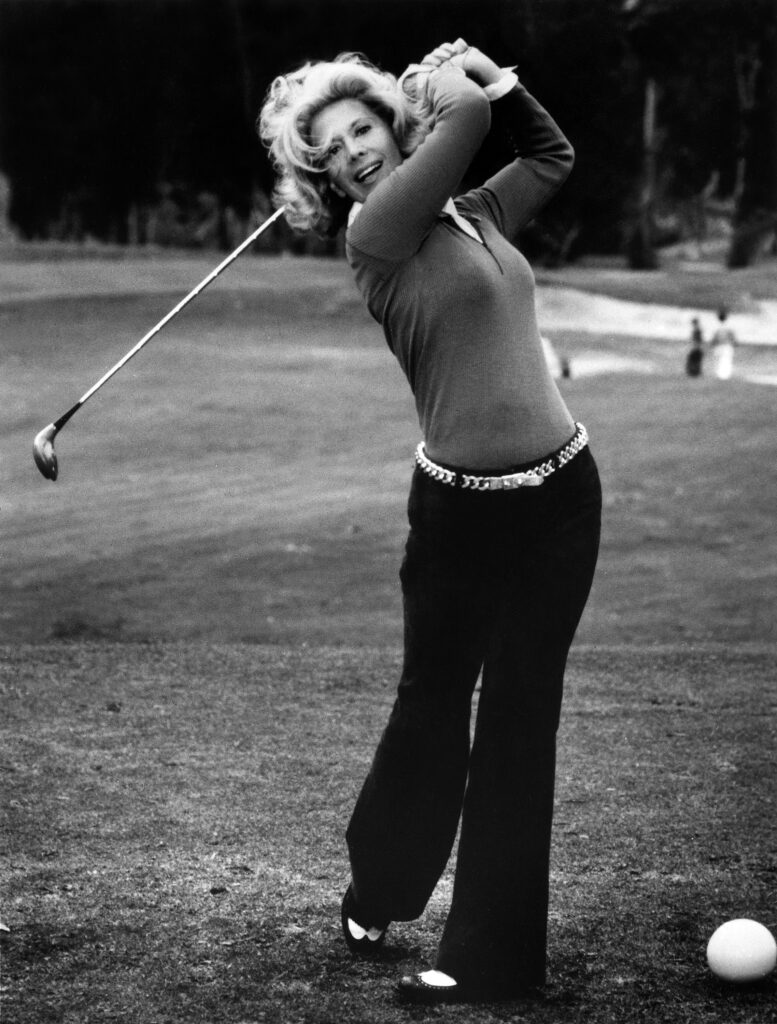
Founded in 1972 by Shore and Colgate Palmolive chairman David Foster, the tournament began as the Colgate-Dinah Shore Winner’s Circle for the first nine editions. Only golfers who had earned a top-three finish in an LPGA event were invited. From 1982 through 1999, Kraft assumed title sponsorship but kept Dinah Shore in the title. By any name, players wanted in.
“As soon as I turned pro in 1975, I was thinking about that tournament,” says Alcott, another member of the SoCal Golf Hall of Fame. “You wanted to win or finish in the top three so you could be eligible for the Colgate-Dinah Shore. Everybody wanted to play in it. When Colgate put all that money into women’s golf, it provided a lot of excitement. And the way the tournament was showcased, with Dinah bringing all her Hollywood friends to play in the pro-am, like Bob Hope and Gerald Ford and Frank Sinatra — women’s golf just didn’t have anything like that.”
Picture Oprah Winfrey hosting a major golf championship and you will have an idea of how significant this was. Jane Blalock, who won the inaugural edition, described to Golfweek in 2022 how huge that first year felt.
“It’s really hard to put into words,” said Blalock. “The prize money stands out because it was a $110,000 purse. It was at least double the amount of any other LPGA purse that year. But that was minor. It was Dinah and it was Colgate. That event changed the entire way that women’s golf was perceived.
“You talk about elevating the status. We had national TV. It was in the promotions. We were in commercials. I spent two days with Madge the manicurist dipping my hand in Colgate Palmolive. Laura Baugh was the Ultra Brite girl. Sally Little, Judy Rankin. It was phenomenal how they promoted it.”
Blalock continues: “When the news broke about Colgate, here you have an international conglomerate Fortune 100 company getting behind women’s golf. It symbolized the complete transition of the LPGA from kind of a barnstorming group to a celebrity status … and everybody just absolutely adored Dinah. She didn’t just lend her name to it, she bought a place at Mission Hills.”
Alcott, of course, catapulted the Dinah Shore into the stratosphere when she celebrated her 1988 victory at Mission Hills by jumping into Poppie’s Pond next to the 18th green, fully clothed, with her caddie. When Alcott won in 1991, at Shore’s suggestion, she made the plunge again, this time with 75-year-old Dinah.
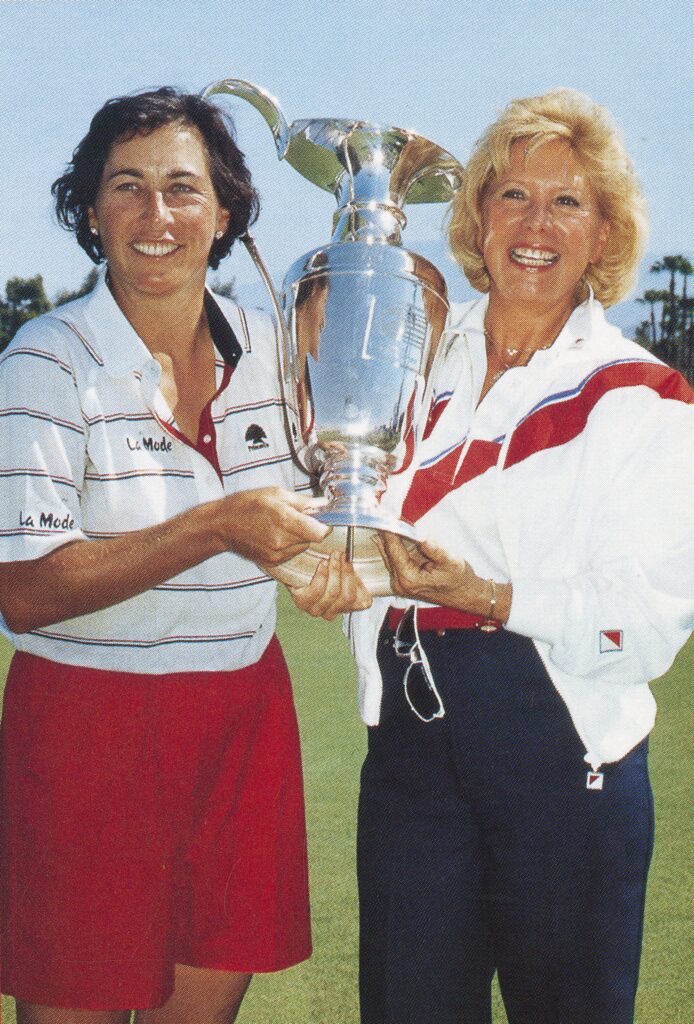
“I had a feeling she would do that because she was in black pants and not in her usual white pants with red jacket,” says Alcott. “Everybody still to this day talks about it. Her assistant had a robe for her and that’s when giving a player a robe became the thing to do when you won the tournament. They gave you a robe. It was amazing.”
Upon Shore’s death from ovarian cancer in 1994, Burt Reynolds reflected with love and admiration. “Hollywood has lost its greatest and only real angel,” he said. “Dinah is what God meant when he strived to make perfection. She was the sunshine in my life and millions and millions of others. She is the only person I ever knew who had nothing bad to say about anyone.”
Shore’s proudest honor, the Peabody Award in 1957 — radio and television’s equivalent to a Pulitzer Prize for writing — featured the inscription, “What TV needs, obviously, is about 100 Dinah Shores.” A similar sentiment clearly resonates: “What golf needs, obviously, is 100 Dinah Shores.”
We’re all fortunate that at least we had one.