A RIVER RUNS THROUGH IT
Jorge Mendoza champions Green River GC as a wildlife sanctuary and a laboratory where youngsters learn to appreciate the beauty
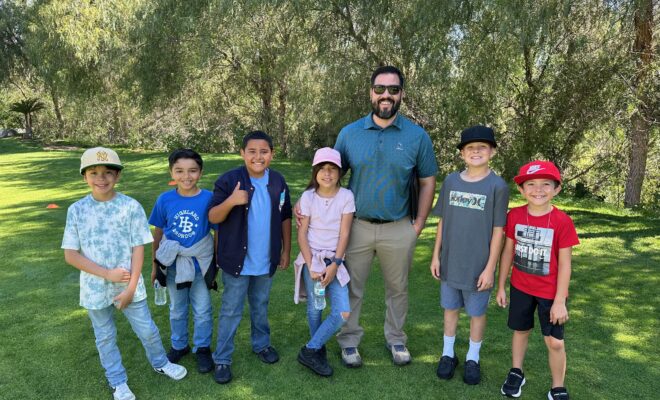
On any given day at Green River GC, you might find course superintendent Jorge Mendoza inspecting the handiwork of second graders from Norco who are assembling and painting bird boxes on an environmentally themed field trip to the Corona course. He might be studying his central control computer that monitors every precious drop of water administered to the Green River fairways. Or he’s out micromanaging that process with a handheld TDR moisture meter (that’s time-domain reflectometry for those of you scoring from home). Or perhaps he’s in the field consulting with a local biologist on how best to manage the course in light of the endangered Least Bell’s Vireos, who’ve chosen to reside there.
Or maybe he’s taking a quiet moment to reflect upon the view, his loyal Mexican wolfdog, Oso, by his side, looking across 18 Kikuyu fairways punctuated by “the best greens in Southern California,” all of it surrounded by the chaparral-cloaked foothills of the Santa Ana Mountains. And oh, yes—a river runs through it: A particularly verdant stretch of the Santa Ana River bisects the course and accounts for its name.
He’s justifiably proud of his greens, but Mendoza is just as proud to declare his course a wildlife sanctuary, where environmental stewardship goes hand-in-hand with top-notch playability. And he’s proud to have now been recognized twice by the Golf Course Superintendents Association of America (GCSAA) as an Environmental Leader in Golf, with runner-up awards for Innovative Conservation and Healthy Land Stewardship.
“We do our best to mirror the Santa Ana Mountains,” he says, reflecting on the setting. The presence of mule deer grazing the nearby hillsides, red-tailed and Cooper’s hawks soaring overhead, plus great horned owls, monarch butterflies, California quail, southwestern pond turtles and those Least Bell’s Vireos all endorse his efforts.
PJ Falatek is a biologist with the Santa Ana Watershed Association who has been monitoring the endangered bird at Green River for the past five years. “The golf course has always been amenable to my activities,” she says. “Nest monitoring lets us know how the vireo population is responding to management efforts like habitat restoration and how the population is doing in general. Green River has always followed my advice on maintenance so that it doesn’t impact the wildlife living on the golf course.”
Mendoza’s affinity for course management came to him naturally. His father, also Jorge Mendoza, is the foreman at Big Canyon CC in Newport Beach. “I started there from the very bottom, hitting hot spots, raking bunkers, working my way up the ladder,” says the younger Jorge. Along the way he acquired a degree in plant soil sciences from Texas Tech and did a stint at Eaton Canyon GC in Pasadena—like Green River, a course managed by environmentally minded CourseCo.
Green River was once a 36-hole complex, but transitioned years ago to an 18-hole course as part of a massive flood-control project. “Over the last several years Jorge and his team were tasked with multiple renovation projects and improvements in this new phase of Green River’s history,” says Tom Bugbee, CEO of CourseCo. “That he has been able to manage these improvements while ensuring the course is a leader in environmental sustainability is absolutely amazing. He finds a way to balance all the needs of this unique course while making sure our core values are front and center.”
Many superintendents don’t want to be under a magnifying glass. I say, put a magnifying glass on me! Look at what we’re doing for the environment.” -Jorge Mendoza

Sustainability is inextricably woven into Mendoza’s mindset and his everyday tasks. It’s an ethos he wants the nongolfing world to understand. “The main reason I’m doing this is to be my own champion for my industry,” he says. “Many superintendents don’t want to be under a magnifying glass. I say, put a magnifying glass on me! Look at what we’re doing for the environment. Compared to many other industries, we do a lot.”
Apart from the 36-to-18 transition, Mendoza has also supervised more recent turf reduction, replacing 10 acres of turf with drought-tolerant native plants. He also enthusiastically supports GCSAA’s First Green program, which brings in students to see Green River as a living laboratory (hence those second graders painting bird boxes). “I love having students come out here. We show the kids how we promote wildlife—how we’re not just some elitist sport that takes up a lot of real estate. This is how we change that perception. Ten to 20 years from now, these kids will be my champions.”